

 Contact Us

QUECHUA LANGUAGE – ONLINE AND/OR IN-PERSON COURSES
Learn Quechua through a community-based and intercultural approach!
This program offers comprehensive instruction in the Quechua language. It aims to develop communication skills in a gradual and methodical manner. A key aspect of our Quechua teaching methodology involves a dialogue with critical theories from Latin America and approaches within postmodern anthropology. An interdisciplinary and intercultural approach enables students to learn the language as a tool for communication while also taking into account the “perspective” through which Quechua society thinks, feels, and uses its language. To this end, a critical examination of conventional Quechua dictionaries, as well as of standard teaching methodologies and didactic approaches to the language, is necessary.
Objetives:
Advantages:
Levels: We use theCommonEuropean Framework of Reference for Languages (CEFR) as our reference. Basic (A1-A2), Intermediate (B1), and Advanced (B2). LEARNING MODALITIES
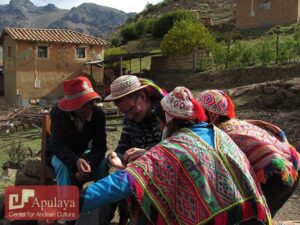
LANGUAGE IMMERSION IN A QUECHUA COMMUNITY: PUT YOUR COMMUNICATION SKILLS TO USE IN A HANDS-ON PARTICIPATORY EXPERIENCE!This program offers a language immersion in a Quechua community. It is a participatory program in which you will have the opportunity to immerse yourself in the community’s language and culture.
Hybrid Quechua course and language immersion in a Quechua communityYou can study online, followed by an in-person program that may include the language stay in the Quechua community. TEACHING STAFF
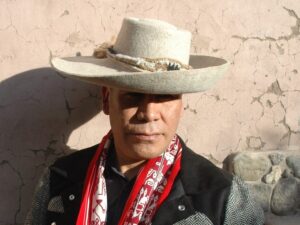
Valerio Fernandez CoronelHe holds a Master’s degree in Musicology from the Pontifical Catholic University of Peru and is a co-founder of Apulaya – Center for Andean Studies. He is a researcher and academic director at our Center, as well as a professor in Quechua, textile semiotics, music, and Andean musicology. He participated in numerous presentations, seminars, and discussion panels and has authored several publications. He hails from the Pataqueña Quechua community in Chumbivilcas, Cusco. His native language is Quechua, his second language is Spanish, and he is fluent in English and German. View his publications here.
Hanny Fernandez CoronelPhD candidate in Anthropology at the Catholic University of Leuven (KU Leuven) in Belgium. She holds a Master’s degree in Social Anthropology from the National University of San Antonio Abad in Cusco, Peru. Her doctoral research focuses on representations and expectations related to education and school in rural communities in Cusco. She has published extensively on the subject of intercultural bilingual education in Quechua. She hails from the Pataqueña community in Chumbivilcas, Cusco. Her native language is Quechua, her second language is Spanish, and she is fluent in English and French.
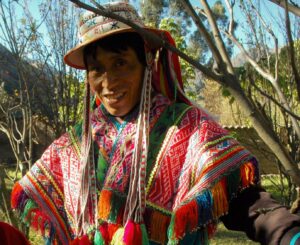
Pedro Mendoza MamaniA community member and agro-pastoralist from the Quechua community of Accha Alta. He is highly skilled weaver. He has served as a varayoq (a political head of the community who carries the staff of authorities). He is a textile art teacher. He acts as a facilitator, instructor, and guide for Quechua students during their language immersion program in his community. He speaks Qechua – his native language – and Spanish which is his second language. Student reviewI am very grateful to have spent the last four weeks at Apulaya, working with Valerio on Quechua (…). Each day, the lessons were carefully prepared by Valerio, who was kind enough to create a personalized program for my daily studies. The program also included (…) [a] stay in the community of Accha Alta, where I was able to practice Quechua and participate (…) in community life, such as planting potatoes. There tayta Pedro and mama Alicia took care of me with great generosity. Izzie, graduate student from Princeton University |
|
|